我的逻辑类
A.第一版
这个小程序是最初的版本。
1。 程序基本说明:这是一个逻辑计算的类,我的思想是这个类可以成为一个判断的实例(proposition),将来通过De Morgen's Law来进行
逻辑计算,并有可能进行逻辑推理,例如,以前我做过的“爱因斯坦”的问题,也许就可以用这个类来做,(很乐观啊!哈哈)
2。 程序思路:我的类为了将来的逻辑计算重载了很多操作符。
A. operator&& 逻辑与。
B. operator|| 逻辑或。
C. operator! 逻辑非。
D. operator== 比较操作符,我是用内定的index来判断两个实例是否相同,这个值得推敲。
E. operator= 复制操作符。
F. bool state 逻辑类的逻辑状态,是核心数据。
G. char* express 逻辑类的名字。
H. static Logic* temp[100] 你想不出这个是干什么的吧?我确实没有什么好主意,在连续运算过程中,每次会返回一个新逻辑
类对象,这对于逻辑运算来说是一些中间过程对象,我把这些中间对象都存在这里,最后再全部释放。我不知道重定向(redirect)
是怎样实现的,对于那些运算他们是返回操作对象本身,这样就相当于赋值改变了对象的状态。例如:A||B&&C, 在A||B运算后必须
返回一个逻辑类对象N来进行"N&&C"的运算,而如果用A或者B做返回,就必须改变A或者B的状态,这不是我所要得。因此,我就产生
新的对象,如果,不在程序结束时消灭,会有很多问题。
3。 主要函数介绍:
A. void catName(char*, const char*, LogicOp); 一个内部方法,主要是把两个对象的名字加上逻辑操作符合成新名字。我原
本用一个局域变量返回其指针,编译器总是报警,运行时候有很多莫名其妙的问题,最后,才明白要把buffer的指针传入。
4。 不足之处:
A. 所有的操作符返回的是对象指针,很不好用,应该改为对象引用。
B. 我原本计划写一个检查方法,比如:假定A is true,然后检查A&&B||C的真假,但是,这很复杂,因为,第一,表达式可能不定长,
这等于我要写一个parser来翻译command命令,天啊!第二,很多对象的真假可能是不确定的,我只有一些所谓“规则”,按照这种
规则和有限的确定的量去进行推理,这种算法,我想可能还没有。
#include <iostream>
using namespace std;
enum LogicOp
{AND, OR, NOT, CONDITIONAL};
char* OpStr[4] = {" AND ", " OR ", " NOT "," CONDITIONAL "};
enum ELEMENT
{R,S,I,W,D,H,F};
char* factStr[7] =
	{"It is raining", "It is snowing", "I get ill","I get wet", "I need doctor",
	"It is hot", "I have a fevor"};
class Logic
{
private:
	static bool status;
	static int logicCount;
	char* express;
	int index;
	bool state;
	void catName(char*, const char*, LogicOp);
	static Logic* temp[100];
	static int tempCount;
	static Logic* TRUE;
	static Logic* FALSE;
	Logic* checkList[30];
	bool definedStatus;
protected:
	void initialize();
	bool compare(const Logic& dummy);
	void uninitialize();
public:
	Logic(const char* newExpress, const bool value=false);
	~Logic();
	Logic();
	bool getStatus() const {return definedStatus;}
	void setStatus(const bool newStatus) {definedStatus = newStatus;}
	void setExpress(const char*);
	char* getExpress() const {return express;}
	void setIndex(const int newIndex) { index = newIndex;}
	int getIndex() const {return index;}
	void setState(bool newState) { state = newState;}
	bool getState() const{ return state;}
	static const int count()  {return logicCount;}
	Logic* operator&&(const Logic& dummy);
	Logic* operator||(const Logic& dummy);
	Logic* operator!();
	bool operator==(const Logic& dummy);
	Logic* operator&&(const bool value);
	Logic* operator||(const bool value);
	Logic* operator=(const Logic& dummy);
	Logic* operator>>(const Logic& dummy);
	void addRule(const Logic* rule);
};
Logic element[7];
int main()
{
	Logic A("A"),B("B"), C("C");
	Logic* ptr;
	A.setState(true);
	C.setState(true);
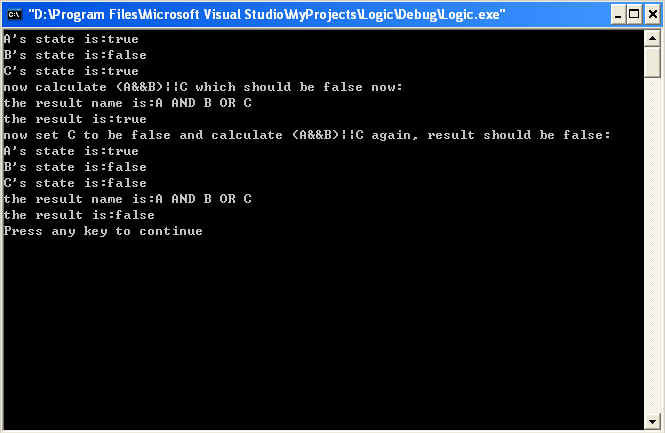
	cout<<"A's state is:"<<(A.getState()?"true":"false")<<endl;
	cout<<"B's state is:"<<(B.getState()?"true":"false")<<endl;
	cout<<"C's state is:"<<(C.getState()?"true":"false")<<endl;
	ptr = (*(A&&B))||C;
	cout<<"now calculate (A&&B)||C which should be false now:"<<endl;
	cout<<"the result name is:"<<ptr->getExpress()<<endl;
	cout<<"the result is:"<<(ptr->getState()?"true":"false")<<endl;
	cout<<"now set C to be false and calculate (A&&B)||C again, result should be false:"<<endl;
	C.setState(false);
	cout<<"A's state is:"<<(A.getState()?"true":"false")<<endl;
	cout<<"B's state is:"<<(B.getState()?"true":"false")<<endl;
	cout<<"C's state is:"<<(C.getState()?"true":"false")<<endl;
ptr = (*(A&&B))||C;
	cout<<"the result name is:"<<ptr->getExpress()<<endl;
	cout<<"the result is:"<<(ptr->getState()?"true":"false")<<endl;
	return 0;
}
Logic* Logic::operator >>(const Logic& dummy)
{
	char buffer[256];
	catName(buffer, dummy.getExpress(), CONDITIONAL);
	temp[tempCount] = new Logic(buffer);
	if (state&&(!dummy.getState()))
	{
		temp[tempCount]->setState(false);
	}
	else
	{
		temp[tempCount]->setState(true);
	}
	tempCount++;
	return temp[tempCount-1];
}
void Logic::uninitialize()
{
	status = true;
	for (int i=0; i< tempCount;i++)
	{
		delete temp[i];
	}
}
bool Logic::status = false;
Logic* Logic::temp[100] = {NULL};
int Logic::tempCount = 0;
Logic* Logic::FALSE = new Logic("FALSE", false);
Logic* Logic::operator =(const Logic& dummy)
{
	setExpress(dummy.getExpress());
	setState(dummy.getState());
	return this;
}
Logic* Logic::TRUE = new Logic("TRUE", true);;
Logic* Logic::operator &&(const bool value)
{
	if (value)
	{
		return (*this)&&(*TRUE);
	}
	else
	{
		return (*this)&&(*FALSE);
	}
}
Logic* Logic::operator ||(const bool value)
{
	if (value)
	{
		return (*this)||(*TRUE);
	}
	else
	{
		return (*this)||(*FALSE);
	}
}
bool Logic::operator ==(const Logic& dummy)
{
	return compare(dummy);
}
bool Logic::compare(const Logic& dummy)
{
	return (index==dummy.getIndex());
}
void Logic::catName(char* buffer, const char* second, LogicOp opcode)
{
	strcpy(buffer, getExpress());
	strcat(buffer, OpStr[opcode]);
	strcat(buffer, second);
}
Logic* Logic::operator !()
{
	char buffer[256];
	strcpy(buffer, OpStr[NOT]);
	strcat(buffer, getExpress());
	temp[tempCount] = new Logic(buffer);
	temp[tempCount]->setState(!getState());
	tempCount++;
	return temp[tempCount-1];
}
Logic* Logic::operator &&(const Logic& dummy)
{
	char buffer[256];
	catName(buffer, dummy.getExpress(), AND);
	temp[tempCount] = new Logic(buffer);
	temp[tempCount]->setState(getState()&&dummy.getState());
	tempCount++;
	return temp[tempCount-1];
}
Logic* Logic::operator ||(const Logic& dummy)
{
	char buffer[256];
	catName(buffer, dummy.getExpress(), OR);
	temp[tempCount] = new Logic(buffer);
	temp[tempCount]->setState(getState()||dummy.getState());
	tempCount++;
	return temp[tempCount-1];
}
int Logic::logicCount =0;
void Logic::initialize()
{
	express = NULL;
	state = false;
	definedStatus = false;
	setIndex(logicCount);
	logicCount++;
}
Logic::~Logic()
{
	if (!status)  //if you destroy one, then you destroy all!!!!!
	{
		uninitialize();
	}
	if (express!=NULL)
	{
		free(express);
	}
}
Logic::Logic(const char* newExpress, const bool value)
{
	initialize();
	setExpress(newExpress);
	setState(value);
}
Logic::Logic()
{
	initialize();
}
void Logic::setExpress(const char* newExpress)
{
	if (express==NULL)
	{
		int i;
		i = strlen(newExpress) +1;
		express = (char*)malloc(i);
		strcpy(express, newExpress);
	}
}


